Turn the Blade
The Ballad of the Last Dragon“Turn the Blade” names a combat principle taught by Neith and later recalled by Sylvaine Abelan at the moment when training becomes the difference between capture and survival. The phrase begins as an instruction to redirect an opponent’s force, but its decisive significance lies in its transformation from technique into embodied memory: when Sylvaine is attacked and outnumbered, Neith’s words return as an immediate command to act rather than surrender.
The Lesson Neith Teaches
Neith introduces the principle during a practice bout with Sylvaine Abelan. The contest begins with a compact challenge, “First to bleed?”, and Neith answers in her clipped speech, “First t’bleed.” She advances more slowly than she is capable of moving, yet the collision of their blades still sends force reverberating through Sylvaine’s already sore arm. Neith tells her to “Follow th’series,” and the two settle into a familiar rhythm that resembles a choreographed dance. Sylvaine meets each strike and deflects every blow, but the success is qualified: Neith is allowing her to do so.
That distinction gives the exercise its purpose. Neith first acknowledges Sylvaine’s ability with “Good. Now turn th’blade,” then immediately changes the conditions by striking harder and faster. Sylvaine barely has time to react; each pass of the sword drives her heart into her throat. When she asks what Neith means, Neith repeats the command and explains its practical demand: for every strike, Sylvaine must turn Neith away and force her onto the defensive. The lesson is not merely to withstand attack. It requires Sylvaine to redirect the attack so that the aggressor loses initiative.
The instruction exposes the gap between recognizing a movement and possessing it under pressure. Sylvaine is drenched in sweat, suffering a pounding head and cramping arm muscles, and admits that she cannot continue. Neith presses harder, insisting that Sylvaine has learned the movements but must adapt to meet the strike and strike back herself. The training therefore shifts from repetition to judgment. Sylvaine must read the attack, alter the expected response, and convert defense into a counterattack before exhaustion makes the distinction academic.
From Rehearsal to Blood
The practice ends with a small but important reversal. Sylvaine catches Neith’s next strike before it can cut her thigh, spins Neith’s sword aside, and launches a cut toward Neith’s arm. Neith remains too fast to be wounded, catches Sylvaine’s sword, and nicks her own blade against the side of Sylvaine’s neck. The sting draws blood, but Sylvaine smiles through her labored breathing and tells Neith that she deserves her own ballad. The moment preserves the hierarchy between them—Neith is still the superior fighter—while proving that Sylvaine has begun to perform the action the phrase demands.
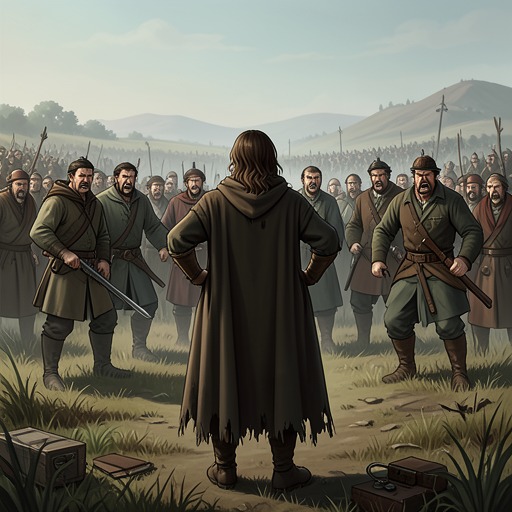
The same phrase later returns under radically different circumstances. During an assault, Sylvaine Abelan is pulled from her hiding place when an attacker catches her lute and drags her down. Her cap flies off, the lute’s wood and strings snap beneath her, and she lands hard on her back before hands seize her again. She claws at the earth, dirt filling her nails and mouth, while screaming and kicking fail to free her. The earlier training scene has prepared the reader to understand what “Turn th’blade” means; the later scene tests whether Sylvaine can retrieve that meaning when fear, pain, and numerical disadvantage make passive defense impossible.
Neith’s voice rings in Sylvaine’s head, followed by the remembered command itself: “Turn th’blade.” The recurrence is not a decorative callback. It functions as a bridge between Neith’s controlled instruction and Sylvaine’s uncontrolled emergency, carrying a piece of Neith’s judgment into a situation Neith is not visibly directing. The phrase becomes a form of combat memory, concise enough to survive panic and force Sylvaine’s attention back onto the immediate mechanics of escape.
The Command in Practice
Sylvaine acts on the remembered instruction by slicing at the grip on her ankle. The attacker lets go and cries out in pain, allowing her to pull free. A blow then erupts against her back, and she turns in time to catch the next strike with her sword. The assailant’s attacks are messy and tactless, but his strength and anger still make Sylvaine’s arms tremble. The scene demonstrates why the lesson is more demanding than simple blocking: strength and fury can make an inelegant attack dangerous, so survival depends on redirecting force rather than waiting for technical perfection from the opponent.
Sylvaine blocks, parries, and disarms him, sending his haft sailing through the air. Her immediate desire is to cheer, jump for joy, and shout, a burst of triumph that reveals how completely the defensive lesson has become an active victory. Yet the victory is sharply limited. Three attackers remain, and Sylvaine is still alone. “Turn th’blade” has enabled a real reversal—from being dragged helplessly across the ground to freeing herself and disarming one attacker—but it has not erased the larger danger. The phrase creates an opening, not a guarantee of safety.
Memory, Agency, and Consequence
As an expression, “Turn the Blade” joins bodily instruction to moral and narrative agency. Neith does not teach Sylvaine to endure injury more gracefully; she teaches her to refuse the role assigned by an attacker. The command changes the value of defense. At first, defense is a posture of survival, and Sylvaine’s task is simply to meet each blow. Neith’s correction makes defense directional and forceful: every strike must be turned away, and the opponent must be driven onto the defensive. The resulting action is a value shift from threatened vulnerability toward partial control, even though the surrounding circumstances remain perilous.
The phrase also gives the two scenes a repeated structure. In training, Neith speaks the words, increases the pressure, and draws blood while Sylvaine attempts to apply them. In the later assault, the words are internally recalled after Sylvaine has lost her position, her cap, and her lute, and they prompt the counteraction that restores a measure of physical agency. The repetition shows learning not as a declaration but as delayed performance. Sylvaine does not master the command because she can explain it; she masters it when the body recalls it before fear can finish immobilizing her.
The expression’s force finally depends on its incompleteness. Neith’s lesson helps Sylvaine escape one grip and defeat one attacker, but the surviving three preserve the danger and prevent the moment from becoming a simple triumph. “Turn the Blade” is therefore neither a promise that skill defeats every threat nor a slogan detached from circumstance. It is a disciplined method of making one opening inside overwhelming pressure, and a compact reminder that resistance begins when the attacked person can redirect the force meant to hold her down.